
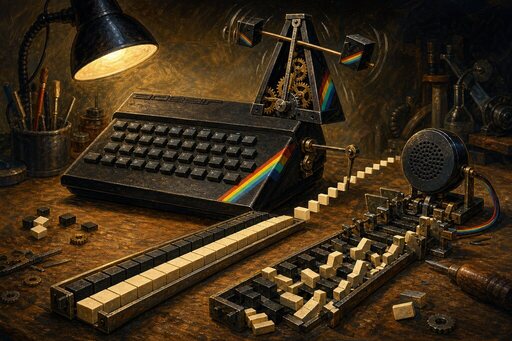
The Sinclair ZX Spectrum, launched in 1982, shipped with only a piezoelectric speaker that could switch on and off, a genuinely primitive sound system. Programmers nonetheless learned to flip that single bit fast enough to fake multiple voices and even crude vocals, turning the limitation into a genre of its own.
Developer Michael Martin's Bumbershoot Software blog has been documenting ZX Spectrum programming since May 2026, starting with "Giving the ZX Spectrum a Fair Shake." His September 5 post, "Experimenting With 1-Bit Sound," focuses on the original 16K and 48K Spectrum models, not the later Spectrum 128, which added the AY-3-8912 sound chip also used in the Timex Sinclair 2068. Martin covers pulse-width modulation and other encoding tricks, and links to a demo called "We are Vocoders" that pushes the format further.
The Spectrum could make music from day one: Steven Vickers' original BASIC manual included code for a short Mahler excerpt. In 2015, Matt Westcott's Mahler Project networked a set of real Spectrum machines to perform all of Mahler's First Symphony together.
A Hacker News thread sparked by Martin's post pointed to composer Tim Follin, who in the 1980s hand-coded intricate scores for Mastertronic's Agent X, its sequel Agent X II, Raw Recruit, Future Games and Chronos, all without extra hardware such as the RAM Music Machine that reportedly impressed musician Aphex Twin. Ben Daglish's demo "Dark Fusion" is cited as another technical showcase, and musician Rich "Tufty" Hollins even produced a full half-hour album of one-bit audio titled "ON and OFF," available on Bandcamp and YouTube.


Comments
No comments yet — be the first.
Open the discussion
No account or password needed — just enter your e-mail and we’ll send you a one-time sign-in link. First time here? You’re set up automatically.
Your rating will be applied automatically after you sign in.
Check your inbox
We’ve sent a sign-in link to …. Open it on this device — this tab will sign you in automatically.
Nothing arrived? Check your spam folder — and mark the mail as "Not spam" so it lands in your inbox next time.