
In 1982, Sony entered a desktop market with no established leaders through the SMC-70. The machine looked conventional from the front, while its rear revealed an unusual expansion design. The Altair’s expansion system later became known as the S100 bus, and the IBM PC used ISA. Both approaches required opening the case to change cards.
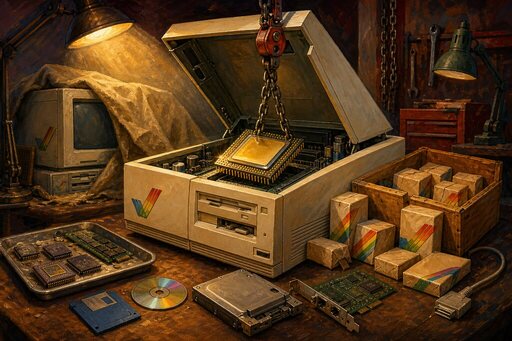
The SMC-70 used modules that could be lined up and mechanically secured with skewer-like rods. Ribbon cables or external cables allowed the stack to run vertically or horizontally. The featured unit needed power-supply work, and a 3D-printed part restored its original appearance.
Its core hardware was familiar for 1982: CP/M running on a 4 MHz Z80. Few CP/M systems used 3.5-inch floppy drives. Sony added 16-color graphics, some sound capability and a module with extensive video-output options. An 8086 module eventually became available, arrived late and did not run MS-DOS. It ran CP/M-86.
The keyboard included a dedicated red help button. The computer also offered a RAM-disk mode, a feature that made power outages particularly inconvenient. A recent Tech Tangents video presents the SMC-70. Sony later produced many other computers.


Comments
No comments yet — be the first.
Open the discussion
No account or password needed — just enter your e-mail and we’ll send you a one-time sign-in link. First time here? You’re set up automatically.
Your rating will be applied automatically after you sign in.
Check your inbox
We’ve sent a sign-in link to …. Open it on this device — this tab will sign you in automatically.
Nothing arrived? Check your spam folder — and mark the mail as "Not spam" so it lands in your inbox next time.