
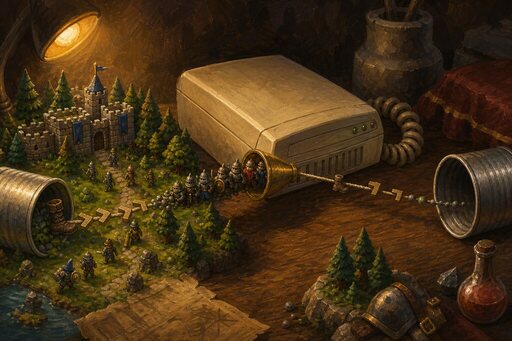
Long before SunOS 2.0 introduced the Network File System (NFS) and the Virtual Filesystem (VFS) switch, diskless workstations relied on a pseudo-device called nd. Unlike NFS, which works at the file level, nd was a kernel block device that sent raw block I/O over the network. Clients found their servers by broadcast instead of by static setup.
Working with nd was very manual and risky. Because physical disks had only a limited number of partitions, the nd driver handled its own subpartitioning. Administrators had to set start and end sectors by hand for every network disk inside a larger partition. The system did no sanity checking, so overlapping partitions were possible and could lead to severe data loss.
To save space, administrators could also use the c partition to expose an entire physical disk to nd, which made it even easier to conflict with local filesystems already on that disk. Manual sector assignment was the only way to give diskless clients storage before NFS replaced this approach.
Nd also avoided both UDP and TCP. It used IP datagrams directly to reduce checksum overhead, a choice shaped by the limited CPU power of 1980s hardware. That meant there were no wire-level integrity checks at all, leaving the data exposed to any network noise or corruption.



Comments
No comments yet — be the first.
Open the discussion
No account or password needed — just enter your e-mail and we’ll send you a one-time sign-in link. First time here? You’re set up automatically.
Your rating will be applied automatically after you sign in.
Check your inbox
We’ve sent a sign-in link to …. Open it on this device — this tab will sign you in automatically.
Nothing arrived? Check your spam folder — and mark the mail as "Not spam" so it lands in your inbox next time.